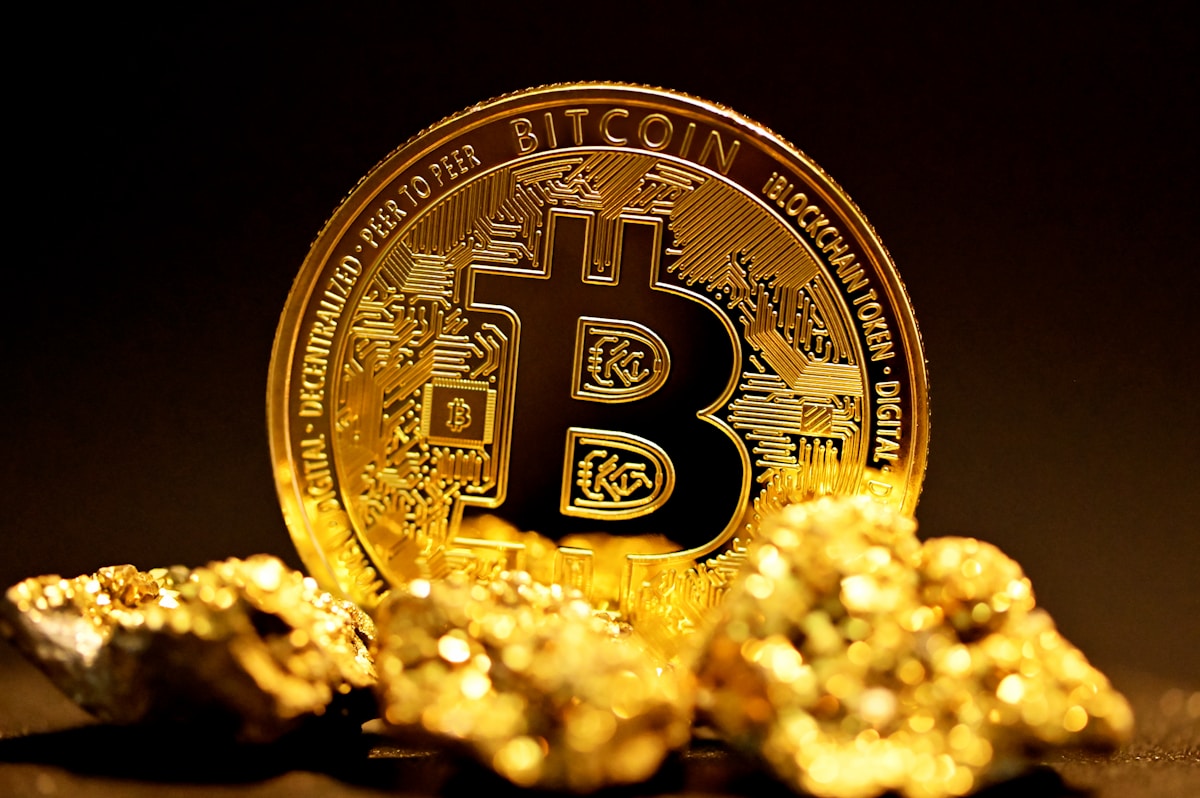
Imagine a form of money that no government controls, no central bank can inflate, and no corporation can shut down. A currency with a fixed supply of 21 million units — hard-coded, unchangeable, enforced by mathematics rather than policy. That’s Bitcoin.
Since its launch in 2009 by the pseudonymous creator Satoshi Nakamoto, Bitcoin has grown from a cypherpunk experiment to a trillion-dollar asset class. The US government now holds over 200,000 BTC seized from criminal cases. BlackRock, the world’s largest asset manager, operates the biggest spot Bitcoin ETF with over $50 billion in assets. And in 2026, Bitcoin is treated by the SEC and CFTC as a commodity — putting it in the same regulatory category as gold and oil.
Whether you’re curious about the technology, considering your first purchase, or trying to understand why Wall Street is piling in, this guide explains Bitcoin from the ground up.
How Bitcoin Works: The Simple Version
The Blockchain: A Public Ledger
Bitcoin runs on a blockchain — think of it as a public spreadsheet that everyone can see but no one can edit retroactively. Every Bitcoin transaction ever made (all 1 billion+ of them) is recorded on this ledger, verified by a global network of computers.
When you send Bitcoin, your transaction is broadcast to the network. Miners — specialized computers running energy-intensive calculations — compete to validate a batch of transactions (a “block”) and add it to the chain. The winning miner receives newly created Bitcoin as a reward. This process, called proof-of-work, secures the network through computational effort rather than trust in any single party.
The 21 Million Cap: Digital Scarcity
Unlike the US dollar, which the Federal Reserve can print in unlimited quantities (the M2 money supply expanded by over 40% between 2020 and 2022 alone), Bitcoin has a hard cap of 21 million coins. This is enforced by the Bitcoin protocol itself — changing it would require consensus from the entire global network, which is practically impossible.
Every four years, Bitcoin’s block reward halves — an event known as the halving. When Bitcoin launched, miners received 50 BTC per block. After four halvings (2012, 2016, 2020, and April 2024), the reward now sits at 3.125 BTC per block. The next halving, in 2028, will drop it to 1.5625 BTC. This geometrically decreasing supply schedule is what gives Bitcoin its “digital gold” narrative.
Around 19.6 million Bitcoin have already been mined. The final Bitcoin won’t be mined until approximately the year 2140. By then, miners will be sustained entirely by transaction fees rather than block rewards.
| Feature | Bitcoin | US Dollar | Gold |
|---|---|---|---|
| Total supply | 21 million (fixed) | Unlimited (Fed discretion) | ~200,000 tonnes mined, more in ground |
| Issuance | Algorithmic, predictable | Federal Reserve policy | Mining rate varies |
| Transfer speed | ~10–60 minutes (on-chain) | Instant (digital) | Physical delivery: days |
| Divisibility | 8 decimal places (1 satoshi = 0.00000001 BTC) | 2 decimal places | Physical limits |
| Censorship resistance | High (decentralized) | Low (banks can freeze) | Medium (physical seizure) |
Bitcoin for US Investors: Regulation, ETFs, and Taxes
SEC Classification: Bitcoin Is a Commodity
Both the SEC and the CFTC have consistently classified Bitcoin as a commodity, not a security. This is enormously significant: commodities fall primarily under CFTC jurisdiction, which is generally less restrictive than SEC securities regulation. While the SEC under Chair Gary Gensler pursued aggressive crypto enforcement, Bitcoin itself has largely avoided being labeled a security — unlike many altcoins and tokens.
In 2026, the Clarity for Digital Tokens Act further codifies this framework, providing clearer jurisdictional boundaries between the SEC and CFTC for digital assets.
Spot Bitcoin ETFs: Wall Street’s Stamp of Approval
January 2024 marked a historic moment: the SEC approved the first spot Bitcoin ETFs — exchange-traded funds that hold actual Bitcoin, not futures contracts. Within months, these became some of the most successful ETF launches in history:
- BlackRock iShares Bitcoin Trust (IBIT) — the largest, with over $50 billion in AUM by 2026
- Fidelity Wise Origin Bitcoin Fund (FBTC) — backed by Fidelity’s own custody infrastructure
- ARK 21Shares Bitcoin ETF (ARKB) — Cathie Wood’s entry
- Grayscale Bitcoin Trust (GBTC) — converted from a closed-end trust, still one of the largest holders
For US investors, spot Bitcoin ETFs mean you can now gain Bitcoin exposure in your 401(k), IRA, or standard brokerage account — without ever touching a wallet or managing private keys. The 0.12%–0.25% annual management fees are a small premium for the convenience.
IRS Tax Treatment
The IRS treats Bitcoin as property — same as stocks or real estate:
- Buying and holding Bitcoin: Not taxable
- Selling Bitcoin for USD: Capital gain (or loss) — short-term if held <1 year (taxed as ordinary income, 10%–37%), long-term if held ≥1 year (0%–23.8% including NIIT)
- Trading Bitcoin for another crypto (e.g., BTC → ETH): Taxable event — you realize a gain or loss on the Bitcoin at its fair market value
- Spending Bitcoin on goods/services: Taxable event — same as selling
- Receiving Bitcoin as payment: Ordinary income at the fair market value on the date received
US investors report Bitcoin transactions on Form 8949 and Schedule D. Most major exchanges now issue Form 1099-DA with your transaction history, making reporting more straightforward.
Why Do People Buy Bitcoin?
- Store of value: With a fixed supply and mathematically predictable issuance, Bitcoin appeals to investors worried about dollar inflation. The US national debt surpassed $36 trillion in 2025, and Bitcoin’s scarcity narrative resonates in that environment.
- Institutional adoption: When BlackRock, Fidelity, and major pension funds allocate to Bitcoin, it signals legitimacy. Corporate treasuries (MicroStrategy alone holds over 250,000 BTC) reinforce the thesis.
- Financial sovereignty: Bitcoin lets you hold wealth that no bank can freeze and no government can confiscate. For residents of countries with capital controls or unstable currencies, this is transformative. For Americans, it’s an additional layer of financial autonomy.
- Asymmetric upside: Bitcoin has delivered a compound annual growth rate of over 100% since inception, though past performance guarantees nothing. The core investment case is that Bitcoin is still early in its adoption curve — if it captures even a fraction of gold’s $13 trillion market cap, the upside is substantial.
How to Buy Bitcoin in the US
Step 1: Choose a Platform
For your first purchase, a regulated US exchange like Coinbase or Binance.US is the simplest on-ramp. You can also buy through a spot Bitcoin ETF in any brokerage account — Fidelity, Schwab, Vanguard — if you prefer the traditional investment route.
Step 2: Fund Your Account
Link your bank account and deposit USD via ACH. Most exchanges credit deposits within 1–3 business days, with some offering instant trading.
Step 3: Buy Bitcoin
Search for BTC-USD, enter the dollar amount (you can buy fractions — $50 worth, $500 worth, any amount), and execute a market order. The Bitcoin will appear in your exchange wallet immediately.
Step 4: Secure Your Bitcoin
If you bought through an ETF, your shares are held in your brokerage account — no further action needed. If you bought actual Bitcoin on an exchange, consider moving it to a hardware wallet (Ledger, Trezor) for long-term storage. Exchanges are for trading; hardware wallets are for holding.
🚀 Ready to Start?
The world's largest crypto exchange 👋 Sign up on Binance with code HERMESS and get fee discounts!
⚠️ This content is for informational purposes only, not financial advice. Crypto investing involves risk. Always do your own research (DYOR).
Common Myths
- “Bitcoin is only for criminals”: Every Bitcoin transaction is permanently recorded on a public ledger. Law enforcement agencies, including the FBI and IRS, use blockchain analytics tools (Chainalysis, CipherTrace) to trace illicit transactions. The vast majority of Bitcoin usage is legitimate.
- “I can’t afford a whole Bitcoin”: You don’t need to buy one whole Bitcoin. The smallest unit is a satoshi (0.00000001 BTC). You can buy $10 worth if you want.
- “Bitcoin is a bubble that will go to zero”: Bitcoin has survived 15+ years, multiple 70%+ crashes, regulatory crackdowns, and exchange collapses. It has a $1 trillion+ market cap, institutional backing, and a global user base. It may be volatile, but “going to zero” is increasingly unlikely.
Risks to Understand
- Volatility: 50% drawdowns are routine in Bitcoin. The 2022 bear market saw BTC drop from $69,000 to below $16,000. If you can’t stomach that, size your position accordingly.
- Regulatory risk: While Bitcoin’s commodity status is the most settled question in crypto regulation, future administrations could change the landscape. The US government’s own Bitcoin holdings (over 200,000 BTC) make an outright ban unlikely, but tax treatment, reporting requirements, and exchange regulations can shift.
- Security risk: If you self-custody, you’re solely responsible. Lose your seed phrase, lose your Bitcoin — permanently. There’s no password reset for Bitcoin.
- Technological risk: While unlikely, a critical protocol bug or a quantum computing breakthrough could theoretically threaten Bitcoin’s cryptography. The open-source developer community actively researches post-quantum upgrades.
Bottom Line
Bitcoin is the most significant financial innovation since the internet. It is simultaneously a technology, a currency, and a store of value — and in 2026, it’s fully integrated into the US financial system through spot ETFs, regulatory frameworks, and institutional adoption.
That doesn’t mean you should go all-in. Bitcoin’s volatility is real, its technology is still evolving, and its regulatory future — while clearer than ever — is not fully settled. The smart approach for US investors: learn the fundamentals, start with an amount you’re comfortable losing, and think in terms of years rather than days.
Bitcoin is 15 years old. The adoption curve still has a long way to go.
🔥 Also on Bybit
Bybit is a top-3 global exchange. Sign up with code 7LMZ0G for trading fee discounts!
Sign Up on Bybit →⚠️ Crypto investing involves risk. Always do your own research (DYOR).