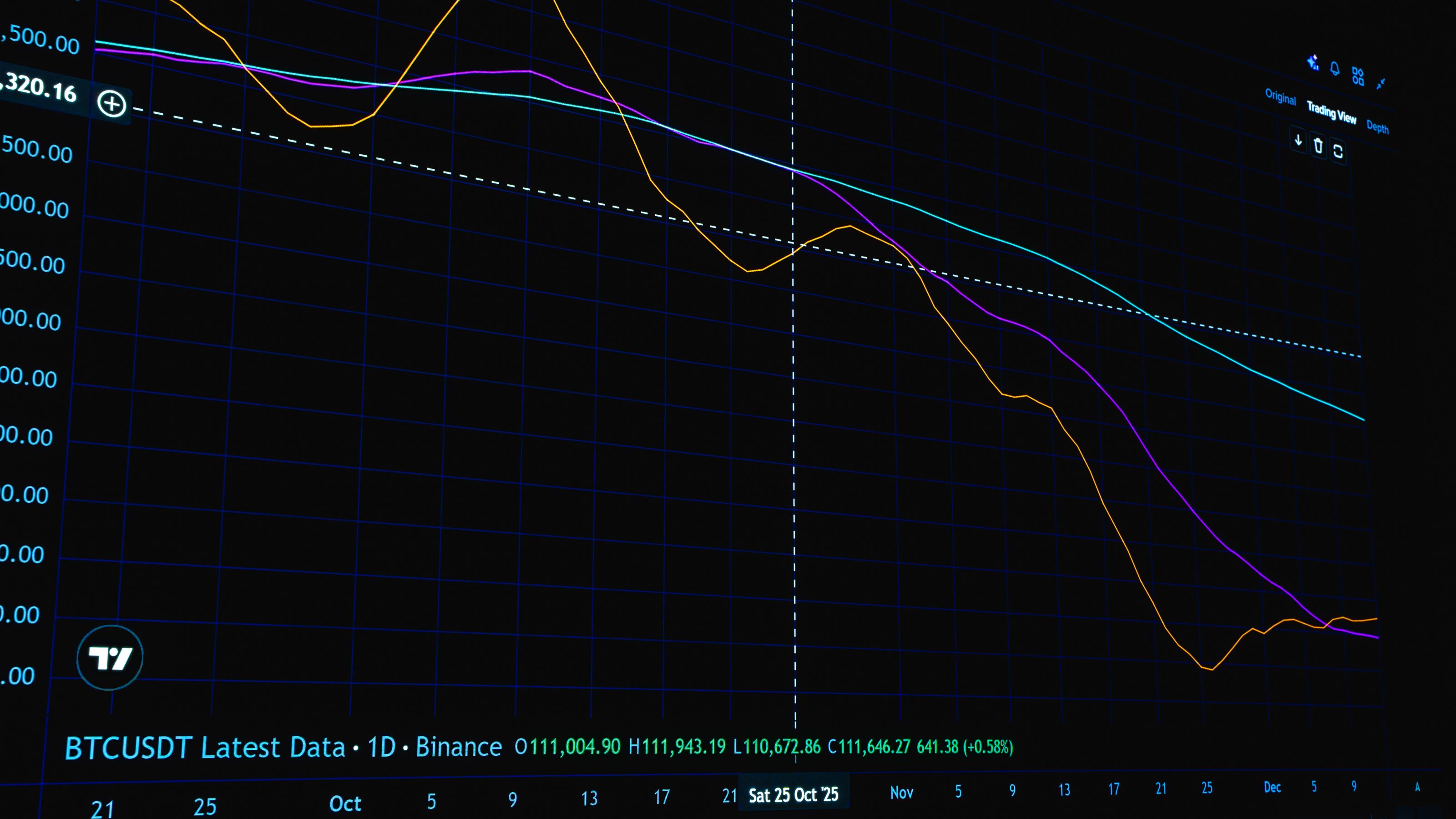
Bitcoin is sitting near $77,000 on a Sunday tape with almost nobody left to sell to — and the two events that decide the next leg are already on the calendar. Two days to the Senate cloture vote on the CLARITY Act. Three days to the FOMC. Institutions are still buying. Long-term holders are still selling. That gap is the whole trade.
This is the last stretch where the market is still handing out the discount, because after Tuesday and Wednesday, probability turns into price.
A Thin Weekend Tape and the Setup Nobody Wants to Admit
Weekend liquidity is thin. Order books thin out, spreads widen, and moves overshoot in both directions. That is the mechanical reason a Sunday setup like this matters: positioning is light, and the people who are wrong get cleared fast when the calendar opens.
The tape is holding inside a $76,000–$80,000 range, with BTC near $77,000 and Ether in the $2,500–$2,600 band. A recent flush took roughly $400 million in leveraged longs out of the market. Every one of those exits was a forced seller that no longer exists. Forced supply is finite; it burns itself out.
Meanwhile the macro backdrop is genuinely hostile and fully priced. US August core CPI ran hot. CME FedWatch puts the odds of a Fed hike at the Sept 16 FOMC at 85.6% (sources range 68%–88%). That would be the first Fed increase since July 2023, taking the funds rate from 3.50%–3.75% to 3.75%–4.00%. The 30-year Treasury yield is at 5.309%, the highest since June 2004, and the 10-year sits at 4.812%, the highest since November 2023.
Read that back: generational long-bond yields, a near-certain hike, a hot inflation print — and Bitcoin is still holding a $76K floor. The bad news is not pending. It is printed.
The Institutions Never Left
Here is the part the doom narrative keeps skipping. US spot Bitcoin ETF total AUM has crossed $100 billion. The week to Sept 4 printed $986.9 million in net inflows, and August was the best month of 2026 for the category.
Money at that scale does not day-trade a weekend gap. It allocates. $100 billion in ETF AUM is a structural bid that shows up on schedule, inside brokerage accounts, during equity market hours — and it is the single most important fact on this page. The largest pool of US-regulated capital ever assembled around Bitcoin is not leaving because of a cloture vote.
281,900 BTC: The Distribution You Should Actually Track
The counterweight is on-chain, and it is real. CryptoQuant’s Axel Adler Jr. flagged that long-term holder 30-day distribution rose from 174,500 BTC to 281,900 BTC between Aug 18 and Aug 28 — a +61.5% jump and the highest reading of 2026. The LTH MVRV climbed from 1.31 to 1.64 over the same window.
Translation: the coins that moved are the ones with massive unrealized gains, and their owners used the post-squeeze rebound to take profit. That is supply, and it has to be absorbed. The good news is who is on the other side. $100 billion of ETF AUM is exactly the kind of standing bid that absorbs it — but only if it keeps showing up. Absorption capacity and new demand are now the whole game.
CLARITY: The 60-Vote Cliff Is Not a Formality
On Sept 15, the Senate holds a procedural cloture vote on the motion to proceed to the Digital Asset Market Clarity Act (H.R. 3633). Understand precisely what that vote is: it needs 60 votes just to open debate. It is not a vote to pass the bill. It is a vote on whether the Senate is allowed to talk about it.
Republicans cannot reach 60 alone, which means at least seven Democrats or independents have to cross over. The sticking point has not moved: an ethics and divestment provision covering government officials who hold digital assets. That single clause is the difference between a statute and another round of agency guidance.
The pressure campaign is public. Treasury Secretary Scott Bessent warned that failing to advance the bill would send a “troubling signal” to allies and adversaries — that Washington cannot organize its own digital-asset rules while the rest of the world writes theirs. Coinbase CEO Brian Armstrong has said crypto gets regulatory clarity either way, which is true over a multi-year horizon and cold comfort on Tuesday afternoon.
What CLARITY Actually Changes for a US Investor
The jurisdictional split is the whole point. Today, SEC and CFTC authority over digital assets overlaps and is largely resolved by enforcement, not statute. CLARITY would draw a line: the CFTC gains expanded oversight of spot digital-commodity markets — exchange, broker, and dealer registration categories — while the SEC keeps authority over investment-contract assets and securities offerings. Tokens could migrate from SEC to CFTC treatment as a network matures and decentralizes. For an American investor, that is the difference between owning an asset with a defined regulator and owning one whose rulebook depends on which agency sues first.
The tax side is no longer optional. The IRS treats digital assets as property: gains on positions held one year or less are short-term and taxed at ordinary income rates, while positions held more than one year can qualify for long-term capital-gains rates. Disposals are reported on Form 8949 and Schedule D. Brokers have been required to report gross proceeds on Form 1099-DA for transactions effected on or after Jan 1, 2025, and for covered securities they must report cost basis and acquisition date for sales on or after Jan 1, 2026. Payee copies were due by Feb 17, 2026. The basis gap is the live risk: assets moved in from another broker or a self-custody wallet can arrive with no basis reported, leaving a $0 cost basis on the record. In a higher-for-longer rate environment, holding-period records are position sizing, not filing hygiene.
On wash sales, know the line as it actually is: spot crypto sits outside the §1091 wash-sale rules, so a loss can be harvested and the position rebought immediately — but tokenized securities are treated differently, and box 1i on the 1099-DA exists precisely to disallow losses on wash sales of tokenized securities under section 1091. Two lanes, two sets of rules.
The cheapest US access route is also evolving. The spot ETF complex has compressed fees hard: IBIT and FBTC both sit at 0.25%, Grayscale’s Mini Trust (BTC) at 0.15%, Franklin’s EZBC at 0.19% — against GBTC’s 1.50%, the legacy fee that drove years of outflows. On $100,000 deployed, that 1.35-point spread between GBTC and the mini trust is $1,350 a year in friction you either keep or hand over. Whichever route fits your account — custody, spot, or an ETF inside a tax-advantaged wrapper — decide the funding rail and the venue before the vote, because the cheapest execution is the one you planned for. And if you want dollar rails rather than bank wires, USDC is the US-regulated stablecoin lane; a plain USDT transfer is just the fastest on-ramp when an exchange is all you have.
The live debate among US retail right now is simple and honest: buy the discount before the vote, or wait for confirmation after it. Buying before means you are paid for accepting headline risk on a 60-vote threshold nobody controls. Waiting means you buy a statute that already repriced. Both are legitimate. What is not legitimate is having no position and no plan when the tape gaps.
The Bull Case That Is Still on the Table
Bernstein has laid out $150,000 by mid-2027, $300,000 by late 2029, and $500,000 in an ultrabull scenario. Kalshi traders put a 72% chance on Bitcoin trading above $80,000 during September — meaning the prediction market’s base case is that this $77K tape prints an $80K handle within the month, with a hike and a vote landing inside that same window.
Those are not small numbers, and they are sitting two days away from the catalyst that decides whether the framework they rest on gets written into law.
The 72-Hour Window
Everything that was going to hurt crypto this week is already on the tape: hot core CPI, a 5.309% long bond, an 85.6% hike bet, and a fresh round of long liquidations. What has not happened yet is the part where the calendar resolves.
Tuesday, Sept 15 — Senate cloture on CLARITY. Sixty votes, or the framework stalls.
Wednesday, Sept 16 — FOMC. A priced hike becomes policy for the first time since July 2023.
Right now — BTC near $77,000, ETF AUM above $100 billion, long-term holders already distributing, and a market that has absorbed every negative print thrown at it without losing the $76K floor.
Get your funding route decided. Pick the exposure that fits your US account. Be positioned before probability turns into price — because this is the last weekend the discount is still on the board.
🚀 Ready to Start?
The world's largest crypto exchange 👋 Sign up on Binance with code HERMESS and get fee discounts!
⚠️ This content is for informational purposes only, not financial advice. Crypto investing involves risk. Always do your own research (DYOR).
🔥 Also on Bybit
Bybit is a top-3 global exchange. Sign up with code 7LMZ0G for trading fee discounts!
Sign Up on Bybit →⚠️ Crypto investing involves risk. Always do your own research (DYOR).