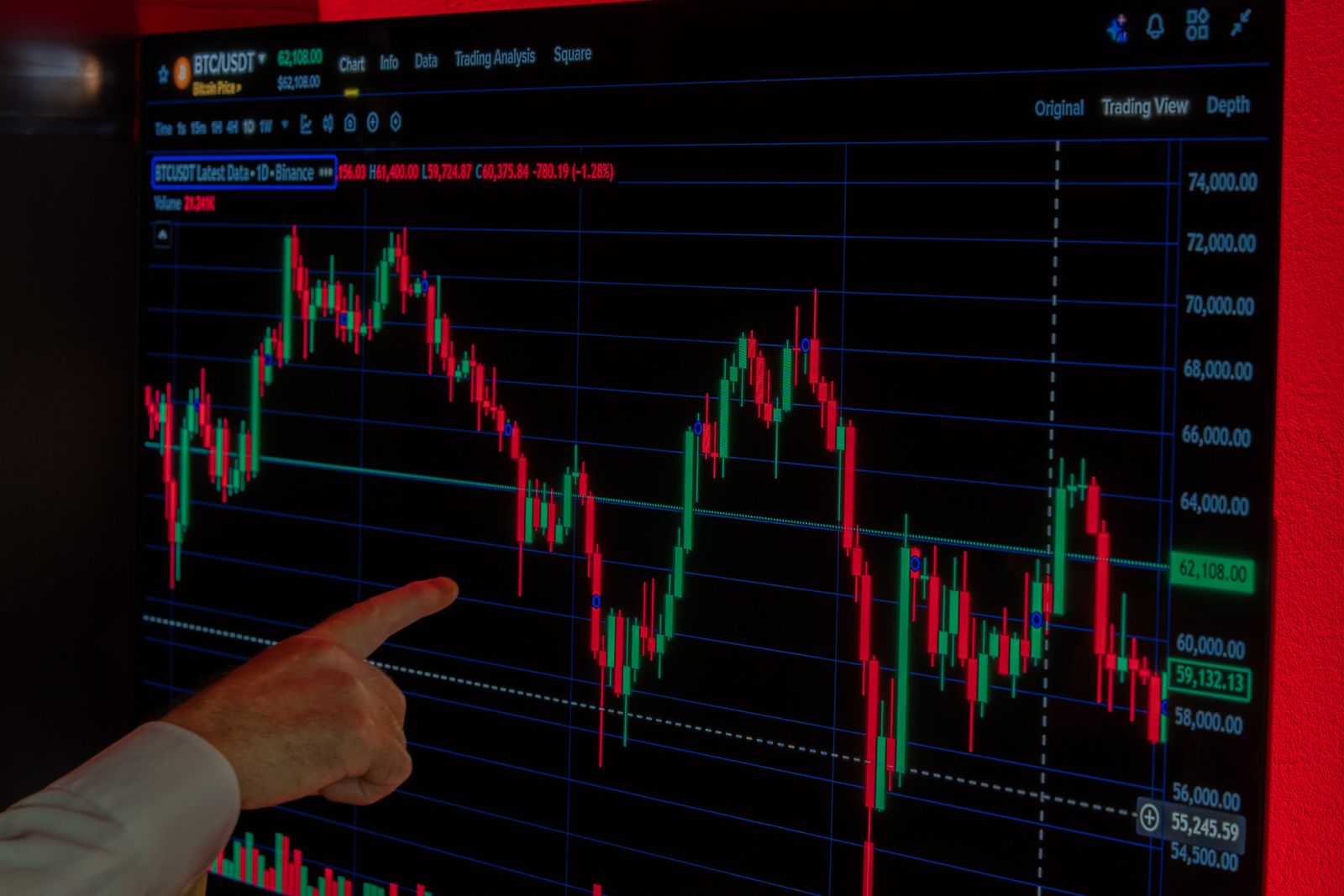
Bitcoin is one day from the vote that decides whether the United States writes a crypto rulebook this decade. The Senate votes tomorrow at 2:15 p.m. ET. Sixty votes, or the legislation is dead until 2029. Right now BTC is sitting near $77,000 — the exact entry everyone claims they wanted, parked in plain sight with the clock running down.
This is not a waiting game. This is the last session where the market is still pricing the question instead of the answer.
The Clock Is the Trade
The whole setup is a calendar. Tomorrow the Senate moves. Wednesday the Fed moves. Between those two events, roughly $77,000 stops being a price and becomes a verdict.
Weekend tape is thin and the order book is shallow, which is precisely why the level has held: there is no seller left to break it. A flush already cleared the leveraged crowd, and forced sellers do not come back. The market absorbed a hot inflation print, a 5% long bond, and a fresh hike bet without losing the $76,000 floor.
Every input that was supposed to break Bitcoin this month is already printed on the tape. The only thing missing is resolution.
What Tomorrow’s Vote Actually Is
Be precise about the mechanics, because the headline writers will not be. Sept 15 is a cloture vote on the motion to proceed to the Digital Asset Market Clarity Act (H.R. 3633). It requires 60 votes just to open debate. It is not final passage. It is a vote on whether the Senate is allowed to talk about the bill.
Republicans hold 53 seats, so at least seven Democrats or independents must cross over. The blocker has been an ethics and divestment clause covering federal officials who hold digital assets. Senate Republicans dropped updated text on Thursday, Sept 10 to address the holdouts, and Treasury Secretary Scott Bessent has publicly pressed lawmakers to support the procedural motion, warning that failing to advance it would send a “troubling signal” to allies and adversaries.
The prediction markets are telling you exactly how narrow this is. Polymarket has slid from roughly 82% in February to about 23% as of Sept 13 — up from 16% after a Friday White House meeting on the ethics language. Galaxy Research puts the odds near 10%.
That gap between price and probability is the entire opportunity. The market has already decided the vote fails.
If cloture fails, here is the scoreboard:
- The bill is effectively dead for 2026. The next realistic legislative window is 2029, because the midterm calendar eats the remainder of this Congress.
- Nothing about Bitcoin’s network changes. A failed vote kills a statute, not a chain.
- The SEC under Chair Paul Atkins and the CFTC’s new Innovation Advisory Committee keep moving anyway. The agencies have already published a joint token taxonomy and a “Regulation Crypto Assets” framework, and the CFTC’s advisory panel now includes the CEOs of both major prediction markets. Washington’s rulemaking does not stop when one procedural motion dies.
- What a failure does change is the timeframe on the clean statutory lane. That is the repricing, and it is one day away.
🚀 Ready to Start?
The world's largest crypto exchange 👋 Sign up on Binance with code HERMESS and get fee discounts!
⚠️ This content is for informational purposes only, not financial advice. Crypto investing involves risk. Always do your own research (DYOR).
The Fed Is the Second Domino
Two days after the Senate votes, the FOMC decides on Sept 16 at 2:00 p.m. ET. CME FedWatch sits in the 80%–90% band for a 25-basis-point hike, which would be the first increase since July 2023 and take the funds rate from 3.50%–3.75% to 3.75%–4.00%.
August headline CPI ran 3.4% against a 3.3% consensus, and core came in hot. Brent is above $100 on the Iran conflict. New Fed chair Kevin Warsh has sided with the hawks and publicly said that if the inflation numbers do not improve, “we have work to do.”
The hike is priced. The hawkish chair is priced. The oil shock is priced. What is not priced is a market that simply refuses to fall while all three land in the same 48 hours.
Where the Money Actually Is
Institutional behavior is the tell, and it is split — which is exactly what a coiled market looks like.
| Signal | Latest reading | What it means |
|---|---|---|
| US spot BTC ETF flows | −$236.5M on Sept 1; −$462.6M for Sept 8–11 | Flow desks trimmed into the CPI print |
| US spot BTC ETF AUM | ≈$101B | The structural bid is still standing |
| Strategy (MSTR) holdings | 840,447 BTC | Largest corporate stack, unchanged |
| Strategy cash | $5.1B reserve + $1.59B new cash pool | Dry powder for the next leg |
| Bernstein targets | $150K mid-2027, $300K end-2029, $500K bull | House view has not blinked |
Read the top two rows together. The same complex that now holds roughly $101 billion of Bitcoin printed a $462.6 million out week as yields spiked. That is a flow desk managing a print, not an allocator abandoning a thesis. ETFs are supply mechanics: every creation pulls coins into custody and every redemption hands them back — and the desks that run those creations respond to the calendar, not to sentiment.
Strategy is the other half of the picture. It raised $2 billion on MSTR share sales, holds 840,447 BTC at an average cost of $75,385, and sold roughly 6,948 BTC this summer — not because it turned bearish, but to fund preferred-stock dividends. Corporate treasuries sell to service obligations. That is treasury management, and with a $5.1 billion reserve behind it, the company has years of coverage and every reason to buy the next dislocation.
The Levels That Decide the Week
Rekt Capital’s map is the one US traders are actually trading against. Bitcoin broke above horizontal resistance at $78,298 and then lost it — and the weekly reclaim is the trigger.
| Level | Role | The read |
|---|---|---|
| $82,195 | Upside target | Next resistance once $78,300 is reclaimed |
| $78,300 | Horizontal resistance | The line that flips this tape bullish |
| $77,000 | Current price | Where the market is parking pre-event |
| $72,848 | Major support | First real floor if the reclaim fails |
| $65,720 | Deeper support | Cycle-structure level |
| $59,433 | Structural support | The line that would break the thesis |
The comparison Rekt Capital is drawing is to May 2026, the last time BTC tangled with this exact structure. The difference now is who is holding the coins: Bernstein estimates roughly 59% of circulating supply has not moved in 12 months, and it still projects $150,000 by mid-2027 with a $300,000 cycle peak by end-2029.
The Revolut Leak Was Not a Bitcoin Problem
Revolut confirmed a breach on Sept 12 after falling for fake government requests. Exposed data included passports, selfies, home addresses, transaction histories and Bitcoin activity. The victims were largely high-net-worth users.
Notice what did not fail. Bitcoin’s network processed every one of those transactions correctly and never leaked a byte. The failure was a company’s verification desk, and it is the cleanest argument in years that platform risk and chain risk are two different things. Watch the chain’s price action — the market did not care, because the market understood the difference.
The US Playbook Before the Bell
Everything below is the mechanics that separate a US reader from an offshore one.
Regulatory lane. The SEC and CFTC have already co-published a taxonomy and are moving under Project Crypto and the CFTC’s Innovation Advisory Committee. A failed cloture vote slows the statutory lane to 2029. It does not slow the agency lane, and the agency lane is the one that decides which tokens are commodities versus securities.
Tax lane. The IRS treats digital assets as property. Positions held one year or less are short-term and taxed at ordinary income rates; positions held more than one year can reach long-term capital-gains rates. Disposals go on Form 8949 and Schedule D. Brokers report gross proceeds on Form 1099-DA for transactions on or after Jan 1, 2025, and report cost basis and acquisition date for covered securities sold on or after Jan 1, 2026 — with payee copies due Feb 17, 2026. The live risk is the basis gap: assets transferred in from a self-custody wallet or another broker can arrive with no reported basis, leaving a $0 cost basis on the record. If you buy the dip this week, your holding-period records are position sizing.
Wash sales. Spot crypto sits outside §1091, so a loss can be harvested and the position rebought immediately. Tokenized securities do not get that treatment — box 1i on the 1099-DA exists precisely to disallow those losses.
Venue lane. US spot ETFs have compressed fees hard: IBIT and FBTC sit at 0.25%, Grayscale’s Mini Trust (BTC) at 0.15%, Franklin’s EZBC at 0.19% — against GBTC’s 1.50%. On $100,000 deployed, the 1.35-point spread between GBTC and the mini trust is $1,350 a year in friction you either keep or hand over.
Funding lane. Decide the funding rail before the vote, not after. Dollar rails run through USDC, the US-regulated stablecoin lane; a plain USDT transfer is simply the fastest bridge when an exchange is the tool in front of you. Pick the exposure that fits your account — ETF inside a wrapper, spot on a US venue, or a self-custody stack — and have the rail open before the tape gaps.
The Last Clean Session
Here is the full board, one day out:
- Tuesday, Sept 15, 2:15 p.m. ET — Senate cloture on CLARITY. Sixty votes, or the statutory lane stalls to 2029.
- Wednesday, Sept 16, 2:00 p.m. ET — FOMC. A priced hike becomes policy for the first time since July 2023.
- Right now — BTC near $77,000, $78,300 the line that flips the tape, $101 billion of ETF AUM still standing, and a market that has eaten every bearish print without losing $76,000.
Tomorrow morning, this becomes a headline. Tonight it is still a price.
Get the funding rail decided and the exposure sized before probability turns into price — because the window that is open right now closes when the gavel drops.
🔥 Also on Bybit
Bybit is a top-3 global exchange. Sign up with code 7LMZ0G for trading fee discounts!
Sign Up on Bybit →⚠️ Crypto investing involves risk. Always do your own research (DYOR).